Pamela Wheeler·Fellows and Gloria's friendship
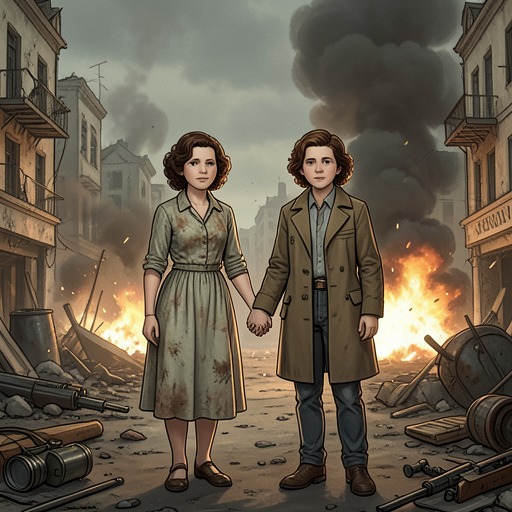
Pamela's WarPamela Wheeler/Fellows and Gloria's friendship is one of the most enduring relationships in Pamela's life. It begins in adolescence, when Pamela is lonely as an only child and Gloria's family temporarily moves into The Woodman Hotel, and it develops through shared pleasures, rule-breaking adventures, family upheaval, and the pressures of the Second World War. Gloria gives Pamela not only a close companion but access to a wider, more cultured world; Pamela, in turn, remains beside Gloria through the gaiety and fear of the years ahead.
Identity and Beginnings
Pamela meets Gloria when she is fourteen and Gloria is twelve. Gloria is the daughter of a successful local businessman, and her family includes twin sisters of about ten. Their circumstances are already marked by rupture: Gloria's mother has abandoned the family, leaving her husband, children, wealth, and beautiful home to run away with a railwayman. While Gloria's father establishes a new home, the family lives at The Woodman Hotel, bringing Pamela into unusually close contact with them.
For Pamela, the friendship answers a particular loneliness. She is an only child, greatly loved by Pamela's parents and accompanied by her little dog, but she returns from school to quiet premises while her parents sleep through the afternoon in preparation for the evening's hotel work. Gloria and her sisters form an instant little family around her. Pamela describes the period as genuinely joyful, and the bond formed then lasts for the rest of their lives.
A Shared Education in Pleasure
Gloria's family is wealthy and well travelled, and Gloria introduces Pamela to experiences beyond the narrower routines of hotel life. Together they attend Shakespeare plays at Stratford, and Pamela develops a lifelong love of opera. Gloria also exposes her to the excitement of fast, open-topped cars and to tastes Pamela presents as new discoveries: champagne and oysters. Their friendship therefore functions as a social and cultural opening, giving Pamela a sense of freedom, refinement, and adult possibility while she is still a schoolgirl.
Although they attend different schools in the same local market town and are separated by two years, Pamela and Gloria become the very best of friends. Their intimacy is not dependent on identical circumstances. It grows from repeated time together, mutual curiosity, and the pleasure of treating the world as an expansive field of experiment.
The Motor-Car Adventure
The friendship acquires a distinctly reckless energy when Gloria, at about thirteen, is presented with a convertible motorcar. The contemporary legal setting makes the escapade possible: a driving test is not yet required, and the girls decide that mastering the controls is enough. Pamela, fifteen and ignorant both of the internal-combustion engine and of road rules, sits beside Gloria while Gloria drives unsupervised.
Because Pamela knows that her father would not permit her to be driven by someone so young, Gloria parks the car around the corner from the hotel. One sunny morning the girls walk down the lane, climb into the car, and set off toward Stourbridge with the roof down, enjoying the sun and wind of the open road. The adventure collapses into alarm when Pamela sees her father approaching in the opposite direction. He is travelling in Pamela's mother's car, with Jack the barman driving because Pamela's father has never learned to drive. Pamela reacts instinctively rather than hiding: she calls out that her father is there and waves. He waves back, and the moment's apparent cheerfulness only heightens the girls' horror when they realise that their forbidden outing has been exposed.
The consequences are immediate and practical. Their wheels are confiscated, and the girls are forced to travel by bus. Yet the punishment does not destroy the friendship; it simply changes the geography of their meetings and turns Saturday excursions into a more deliberate ritual.
Saturdays, Stories, and Geoff
After the car is taken away, Pamela and Gloria meet every Saturday in Stourbridge. Their routine begins at the tobacconist, where they buy Turkish cigarettes because the dark, mysterious shop and the strong tobacco smell seem to embody adult sophistication. The cigarettes burn their throats and are difficult to inhale, but the girls can smoke them freely in restaurants, cinemas, and the ice-cream parlour. Pamela hides the habit from her father, although he is himself a heavy smoker. The cigarettes later become the beginning of Gloria's lifelong nicotine addiction and contribute to shortening her life, giving their youthful experiment a grave retrospective consequence.
The girls then eat a light lunch at Cranages in the High Street, with its curved-glass frontage, and attend the local cinema. They buy the novel on which the film is based and spend the following weeks savouring every word. Their romantic imagination turns them into heroines of Mandalay, the Tara plantation house, Rebecca, and Scarlett O'Hara. At the perfect age for romantic dreams, they use fiction not merely as entertainment but as a shared language for imagining themselves.
Their book-buying trips commonly end at the Italian coffee shop and ice-cream parlour they call Googleomo's. There they often meet Gloria's cousin Geoff, who works in his family's butchery business. Geoff becomes a good friend of Pamela's, and the friendship continues through letter writing during the early years of his war service. It stops after his capture, but Pamela preserves his last letter and eventually returns it to him when they meet as adults. Gloria's social world thus extends Pamela's relationships while remaining rooted in the companionship that brought them together.
Parties and Wartime Companionship
By the time Gloria's father has established the family in a beautiful detached house in Pedmore, their friendship has moved beyond daytime outings into a regular social life. Gloria's father loves champagne, music, and parties, and he hosts one at the house almost every weekend. Because he is one of Pamela's father's best friends, Pamela's father trusts him with her welfare.
Pamela must first complete her duties behind the cocktail bar at The Woodman Hotel, wait until the bar is shut, vacuum the carpet, and tidy up. Only then is she allowed to join the party. Wartime travel restrictions mean that she can stay overnight safely at Gloria's home, and Gloria's father, sometimes still dressed in pyjamas and a dressing gown, reliably brings her home on time for work the next morning. The arrangement gives Pamela a carefully sanctioned form of freedom: her father permits the visit, but he misunderstands its extent, assuming that she turns in after a couple of drinks and sleeps soundly. Pamela does not correct him. Knowing every dance step through earlier instruction and illicit lessons, she dances through the night almost every Saturday.
The friendship's emotional importance becomes clearest when wartime loss enters their shared life. On 5 September 1941, Pamela travels with Gloria to Dudley for a friend's wedding. During the service, despite the happiness of the occasion, Pamela is seized by an overwhelming feeling of doom and becomes physically ill. She tells Gloria that she is certain her beloved David has died, though she cannot explain how she could know. Gloria is the person to whom Pamela first communicates this foreboding, making the friendship a channel for an experience that is both intimate and impossible to prove.
War, Loss, and Lasting Significance
The atmosphere surrounding the girls changes as the war intensifies. The glow of Coventry's fires can be seen from forty miles away during the bombing of 14 November 1940, while London and other beautiful cities endure sustained attacks. Families are divided by evacuation, and shared misery draws communities together even as it produces lasting damage in private relationships. Pamela and Gloria's friendship belongs to this larger wartime emotional structure: it carries pleasure forward, but it also becomes a place where fear, foreboding, and grief can be spoken.
Pamela's heart breaks after David's death, and the losses around her multiply. Max dies in his Stirling bomber during a raid over Germany, while the original group of twenty young men who once came for a drink diminishes week by week as men disappear, are reported missing, or are presumed dead. The brevity and silence of official information make the losses worse. Against that pattern of disappearance, Gloria's continuing presence gives Pamela a form of emotional continuity.
Their friendship also reflects the practical social bonds of the British wartime community. At The Woodman Hotel, ordinary spaces are repeatedly transformed by the war: the lane opposite leads toward the Clent Hills and a nursing home with vegetable grounds; the elevated bar allows Pamela to watch the police station's top sash window and warn customers when the Sergeant puts on his helmet; young men drill behind the station as the Home Guard; and soldiers from a nearby searchlight battalion bring their rations to Pamela's mother for cooking. In such a setting, friendship is not detached from circumstance. It is sustained through roads, houses, hotel rooms, parties, work, and the shared management of danger.
When victory celebrations finally fill the country with bunting, Union Jacks, street parties, food, fireworks, and bonfires, wartime joy is still shadowed by uncertainty. At John Fellows's parents' home, the family knows that John is safe but has heard nothing from Rex for months; the telegram that arrives during the celebrations threatens to turn public victory into private dread. Pamela and Gloria's bond has endured across precisely these contrasts: exuberant parties and confiscated cars, Turkish cigarettes and serious consequences, romantic films and wartime death. Its decisive significance lies in that endurance. Gloria is not simply Pamela's childhood companion; she is the lifelong friend who makes adolescence expansive and remains associated with the memories through which Pamela measures both freedom and loss.